

Halo Academy Learning Hub
Kickstart your journey with expert-led courses, hands-on resources, and real-world skills.

Halo Academy
 0 comment
 02 Sep, 2026
IV therapy is changing the way many people think about modern wellness. Behind every successful IV treatment, however, there is something far more important than the drip itself: knowledge, clinical skill and patient safety.
For healthcare professionals looking to move into the growing world of aesthetic and wellness treatments, becoming an IV therapy practitioner in UK can open the door to an exciting area of professional development.
But where do you actually begin?
What training do you need? Do you need to be a registered healthcare professional? What skills should you develop before offering IV treatments? And how can specialist IV therapy training in UK help you build confidence?

What Is an IV Therapy Practitioner?
An IV therapy practitioner is a suitably trained healthcare professional who delivers intravenous treatments within their professional scope, training and applicable clinical requirements.
Unlike treatments that are simply applied to the surface of the skin, IV therapy involves accessing a vein and administering a solution directly into the bloodstream. That means practitioners need more than an interest in wellness. They need appropriate clinical knowledge, practical skills and a strong understanding of patient safety.
Why quality training matters.
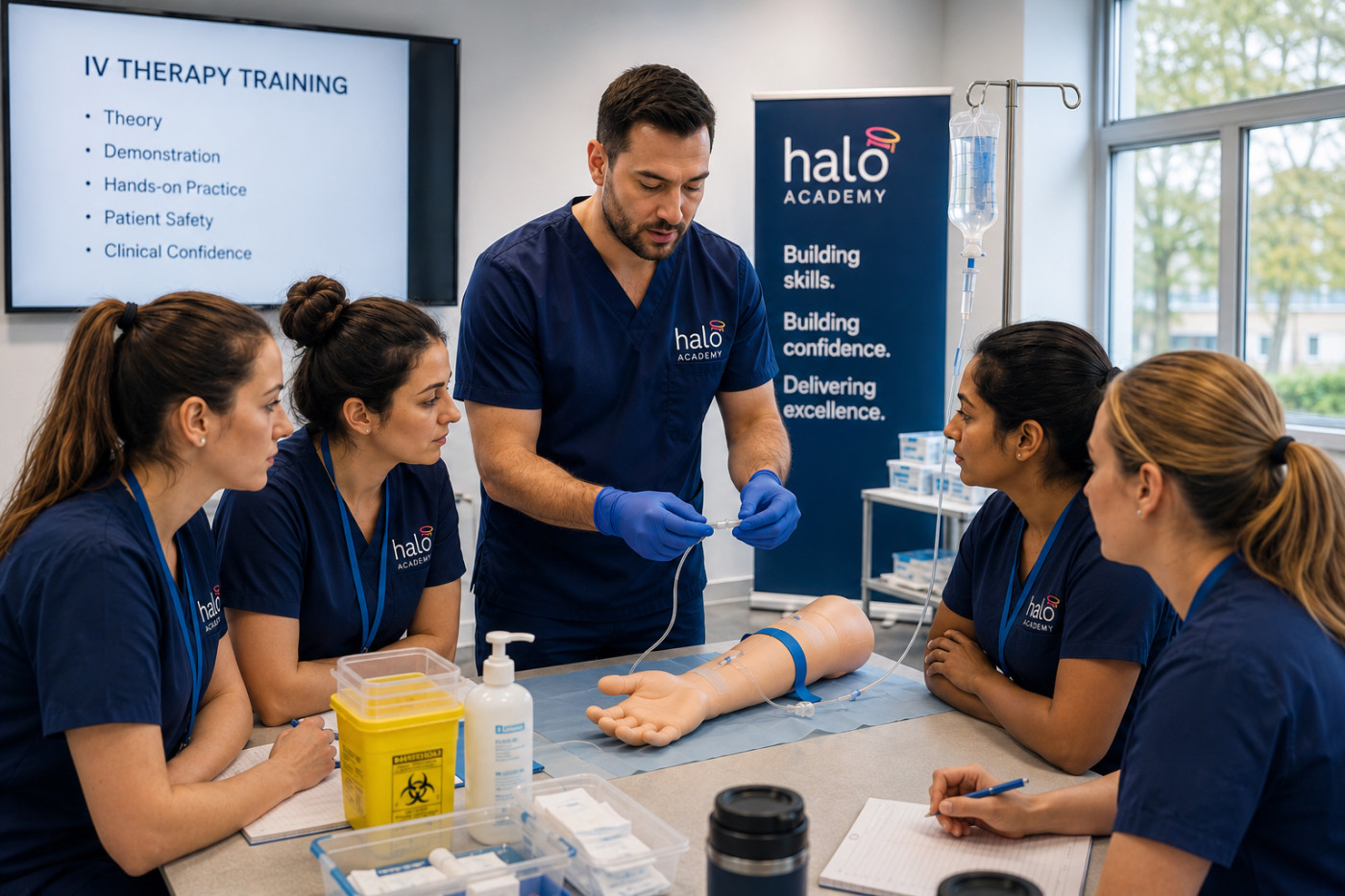
At Halo Academy, IV therapy education is built around developing practical, real-world skills alongside theoretical knowledge. The academy describes its approach as hands-on clinical training, with supervised experience designed to help Learners Bridge the gap between theory and confident practice.
Do You Need Qualifications to Provide IV Therapy in UK?
This is one of the most important questions to answer before entering the field.
IV therapy is a clinical procedure. The requirements for practising safely can depend on your existing profession, scope of practice, employer, treatment offered and the relevant UK regulatory framework.
For example, registered nurses are expected to meet the Nursing and Midwifery Council's standards of proficiency, which set out the knowledge, skills and attributes nurses must demonstrate.
Other regulated healthcare professionals have their own professional standards and scope-of-practice requirements. The HCPC, for example, states that its registrants must meet the standards relevant to their scope of practice and continue to practise safely and effectively within that scope.
So, completing an IV therapy course should not be viewed as a replacement for a regulated healthcare qualification where one is required.
Instead, specialist IV training can help an appropriately qualified professional develop additional knowledge and practical competence relevant to IV treatments.
Step 1: Understand Your Existing Professional Background
Before choosing an IV therapy training course, take a close look at your current qualifications and professional registration.
Are you already a nurse, doctor or another regulated healthcare professional?
If so, your existing clinical education may provide an important foundation. You should still consider whether IV therapy falls within your professional scope and whether additional training, supervision or workplace requirements apply.
Professional standards are not simply paperwork. They exist to protect patients and help practitioners understand the boundaries of safe practice.
The HCPC describes scope of practice as the areas where a professional has the knowledge, skills and experience necessary to practise safely and effectively.
That principle should remain at the centre of any career in IV therapy.
Step 2: Build Strong IV Therapy Knowledge
Once your professional foundation is clear, the next step is developing specialist knowledge.
A good IV therapy course UK programme should go beyond simply showing you how an IV procedure works.

You should develop an understanding of areas such as:
IV therapy principles
Anatomy and physiology
Venous access and cannulation
Phlebotomy principles
Infection prevention and control
Patient assessment
Treatment considerations
Contraindications and potential risks
Safe administration principles
Emergency awareness
Aftercare and documentation
The goal is not simply to memorise a procedure.
It is to understand why each step matters.
That difference can transform a practitioner from someone who has watched an IV procedure into someone who understands the clinical reasoning behind safe practice.
Step 3: Develop Practical Cannulation Skills
Theory gives you the foundation. Practical training helps turn that knowledge into confidence.
IV cannulation training is an important part of developing competence because venous access requires precision, awareness and appropriate technique.
It is not something that should be learned casually from a video or a written guide.
Hands-on training allows learners to understand equipment, positioning, technique and the practical challenges that can arise during venous access.
Halo Academy currently offers an IV Vitamin Drip Cannulation, Phlebotomy Training course alongside its wider IV therapy training options.
This practical focus reflects an important principle in clinical education: confidence should come from supervised learning and appropriate practice, not guesswork.
Step 4: Learn About Patient Safety
Successful IV treatment is not simply about inserting a cannula correctly.
Patient safety should remain the priority from the initial consultation through to aftercare.n effective practitioner needs to understand when a treatment may be inappropriate, when further assessment may be required and when a patient should be referred or treatment stopped.
This is also where professional standards become particularly important.
The NMC sets standards for registered nurses, while the HCPC sets professional standards for its regulated professions. These frameworks reinforce the importance of practising safely, maintaining competence and working within an individual's professional scope.
For anyone entering IV wellness therapy, this safety-first mindset should never be treated as an optional extra.
Step 5: Choose the Right IV Therapy Training Course

Not every course will provide the same learning experience.
When researching IV therapy courses in the UK, look beyond the course title and ask what you will actually learn.
Consider whether the training includes:
Experienced trainers
Practical, hands-on learning
Relevant IV therapy theory
Cannulation and phlebotomy education
Patient safety
Clinical considerations
Opportunities to develop practical confidence
Support during and after training
Halo Academy's current course portfolio includes specialist options such as Halo IV Exclusive Vitamin Drip Training, NAD+ IV Drip Training, CoQ10 IV Drip Training and Curcumin IV Drip Training, as well as IV cannulation and phlebotomy training.
This allows learners to explore different areas of IV therapy and wellness training according to their professional development goals.
Step 6: Continue Developing Your Skills
Completing an IV therapy course is not the end of the journey.
Healthcare changes. Techniques develop. Professional guidance evolves. Your own experience also grows over time.
A strong practitioner should continue learning, reviewing their knowledge and keeping their professional skills current.
This is particularly important when working within aesthetic and wellness settings, where practitioners may encounter different patient needs and treatment considerations.
Professional regulators also emphasise continuing competence and development. The HCPC, for example, includes continuing professional development within its professional standards framework.
The best practitioners never stop learning.
Can IV Therapy Training Help Your Aesthetic Career?
For healthcare professionals already working in aesthetics, wellness or related clinical environments, IV therapy training can add another specialist skill to their professional portfolio.
IV treatments have become increasingly visible within the wider wellness and aesthetic sector, creating interest among practitioners who want to expand their clinical knowledge.
However, entering this field should never be driven by trends alone.
A professional reputation is built on competence, patient care and responsible practice.
Training can help you develop the knowledge and practical foundation needed to approach IV therapy with greater confidence.
Why Hands-On Training Matters

Imagine learning to perform a clinical procedure entirely from a screen.
You can read every instruction.
You can watch every demonstration.
You can understand the theory.
But the first time you face a real clinical situation, theory suddenly becomes very different from practice.
This is why hands-on education matters.
Halo Academy states that its clinical training focuses on real-world skills, supervised practical experience and the use of clinical tools and live models to help bridge the gap between theory and confident practice.
For aspiring IV therapy practitioners, that practical experience can be an important part of professional development.
The Future of IV Therapy Starts With Proper Training
Becoming an IV therapy practitioner in UK is not simply about learning how to administer a drip.
It is about building a professional foundation.
It means understanding your scope of practice, developing appropriate clinical knowledge, learning practical IV skills, prioritising patient safety and continuing your education.
For the right healthcare professional, IV therapy can become an exciting addition to an existing career in aesthetics, wellness or clinical practice.
But the most successful journey starts with one decision:
Choose education that puts competence before confidence and patient safety before everything else.
If you are ready to explore specialist IV therapy training in UK, Halo Academy offers a range of IV therapy and clinical skills courses designed around practical learning and professional development. From IV vitamin drip theory to cannulation and phlebotomy training, the academy provides opportunities to build knowledge and practical skills for the next stage of your career.
Halo Academy
Unlock your potential with Halo Academy’s premier training courses tailored for Doctors, Dentists, Pharmacists, Nurses, Paramedics, Phlebotomist professionals. Our expertly designed programs provide comprehensive education, and the latest industry insights to ensure you excel in IV therapy.
0 comment